according to kristeller, whats one way that behavioral therapy and meditation differ?
'Mindfulness' is a common translation of a term from Buddhist psychology that means 'awareness' or 'blank attention'. It is often used to refer to a way of paying attention that is sensitive, accepting and independent of any thoughts that may be nowadays. The definitions quoted in Box 1 represent some different ways of expressing this. Although mindfulness can sound quite ordinary and spontaneous, information technology is the antithesis of mental habits in which the mind is on 'automatic pilot'. In this usual land, most experiences pass past completely unrecognised, and awareness is dominated by a stream of internal comment whose insensitivity to what is immediately present tin can seem mindless. Although well-nigh people knowingly experience mindfulness for very brief periods only, it tin be developed with practice.
Box ane Some definitions of mindfulness
Mindfulness is:
'facing the blank facts of experience, seeing each event as though occurring for the beginning time' (Reference GolemanGoleman, 1988: p. 20)
'keeping one's consciousness live to the present reality' (Reference HanhHanh, 1991: p. 11)
'paying attending in a detail fashion: on purpose, in the present moment, and nonjudgmentally' (Reference Kabat-ZinnKabat-Zinn, 1994: p. 4)
'sensation of present experience with acceptance' (Reference Germer, Germer, Siegel and FultonGermer, 2005: p. 7)
Differences can exist discerned in how dissimilar practitioners use mindfulness. Some of these reflect the hazards of translation and others reflect longstanding ambiguities within Buddhist psychology (for an extended discussion see Reference Mace, Ancho, Miller and MathersMace, 2006b , Reference Mace2007). 1 nuance that should not be overlooked, because it has implications for therapeutic practice, is axiomatic from the way mindfulness tin be used to announce self-awareness or cocky-consciousness as well as an sensation of what is immediately present. There is an important element of self-recollection in traditional Buddhist conceptions of mindfulness as well, evident when the sensation of internal psychological events such as feelings and patterns of thought is promoted through deliberate verbal reflection, as in 'Now I am doing x, now I am feeling y'. Although this sort of internal commentary, and its emphasis on a cardinal 'I', is not at the center of modernistic conceptions (cf. Box ane) information technology helps in agreement how mindfulness sometimes gets dislocated with Reference Fonagy, Gergely and JuristFonagy et al's (2002) concept of mentalisation. Equally a cogitating capacity that is neatly summarised as 'listen-mindedness', or the capacity to discern whole mental states in others, mentalisation remains singled-out from any of these conceptions of mindfulness because of what Reference Brown and RyanBrown & Ryan (2004) refer to equally the latter'due south 'prereflexive' quality.
Although definitions such as those in Box i are not misleading, they tin fail to convey the implications of being mindful. It might be hard to sympathize why, in ordinary circumstances, anybody should seek this sort of adjustment in awareness, other than for a relaxing mental recharge. I respond, in psychological terms, is that practising being mindful leads progressively to awareness of and liberty from mental conditioning. (In that location is some objective evidence for this from responses to projective tests: e.one thousand. Reference Brown, Engler, Wilber, Engler and BrownBrownish & Engler, 1986.)
Interest in the potential health benefits of mindfulness has fuelled attempts to define its components more conspicuously through empirical inquiry. These are in their infancy, but indicate that 2 components could be principal: a capacity to direct and maintain receptive awareness, and sustaining an accepting attitude towards all experience (Reference Bishop, Lau and ShapiroBishop et al, 2004). Studies of relatively inexperienced practitioners of mindfulness show such a high correlation between these aspects that it has been suggested the kickoff alone might exist taken as a marker of its depth (Reference Brown and RyanChocolate-brown & Ryan, 2003). Even so, recent tentative findings propose that accumulating experience leads to a continuing deepening of non-reactivity once the capacity to maintain an open awareness develops to a consistent level (R. A. Baer, 2006, personal communication). Indeed, inquiry continues to ostend that some facets of mindfulness sally only with experience (Reference Mace and Delle FaveMace, 2006a ), making it essential that length of exercise is taken into account in experimental assessments.
Given that not all commentators agree on what is specific to mindfulness, and its chapters to vary according to individuals' experience, generalisations most neurobiological correlates have to be treated with caution. It does seem that development of the chapters to maintain a continuing not-verbal awareness of being aware has been associated with increased coherence of the electroencephalograph (EEG), and that bilateral slowing is unremarkably found during mindful meditation (Reference AustinAustin, 2006). More speculative findings concerning disproportionate prefrontal activation in new students of mindfulness remain to be confirmed (Reference Davidson, Kabat-Zinn and SchumacherDavidson et al, 2003), but have interesting implications as they accept also been associated with positive changes in bear on.
Techniques for developing mindfulness
Some people develop mindfulness because pursuits such equally regularly playing a instrument tin can foster it. Still, it is usually learned through a mixture of guided instruction and personal practice. The techniques that are generally used (Boxes ii and 3) can exist divided into those that require periods of withdrawal from other activities to practice extended exercises (formal practices) and those that tin can be undertaken throughout the day, amongst other activities (breezy practices).
Box 2 Techniques for experiencing mindfulness
Formal practices
-
• Sitting meditations (attending to breathing, body sensations, sounds, thoughts, etc.)
-
• Motion meditations (walking meditation, mindful yoga stretches)
-
• Group exchange (led exercises, guided discussion of experience)
Informal practices
-
• Mindful activity (mindful eating, cleaning, driving, etc.)
-
• Structured exercises (cocky-monitoring, problem-solving, etc.)
-
• Mindful reading (especially poetry)
-
• Mini-meditations (e.g. the 'three minute breathing space')
Box iii Sample instructions for mindful breathing
-
i Settle into a comfortable, balanced sitting position on a chair or flooring in a repose room.
-
2 Go along your spine erect. Allow your eyes to close.
-
3 Bring your awareness to the sensations of contact wherever your torso is being supported. Gently explore how this really feels.
-
four Become aware of your body's movements during breathing, at the chest, at the abdomen.
-
five As the breath passes in and out of the body, bring your sensation to the irresolute sensations at the intestinal wall. Maintain this awareness throughout each breath and from one breath to the side by side.
-
half-dozen Let the breath simply to breathe, without trying to alter or control information technology. Just noticing the sensations that get with every movement.
-
7 As before long as y'all notice your listen wandering, bring your awareness gently back to the movement of the abdomen. Exercise this over and over again. Every time, information technology is fine. It helps the awareness to grow.
-
8 Be patient with yourself.
-
9 Later 15 minutes or so, bring the awareness gently back to your whole body, sitting in the room.
-
10 Open up your optics. Be ready for whatever's next.
Mindfulness and psychotherapy
Mindfulness places 'attention' at the eye of psychotherapy. Given that psychotherapy depends so heavily on the interaction between therapist and patient, it is remarkable how niggling prominence attention has received. Notable exceptions accept included Freud, who believed psychoanalysts' attention to exist essential to their practice. The psychoanalyst should maintain:
'evenly hovering attention... all witting exertion is to be withheld from the capacity for attention, and one's "unconscious memory" is to be given total play; or to express it in terms of technique, pure and uncomplicated: i has simply to mind and not to trouble to go on in mind anything in particular. Failure to do this risks "never finding anything but what he already knows" ' (Reference Freud and StracheyFreud, 1912: pp. 111–112).
An equally significant injunction of this kind can be found, appropriately, in the English psychoanalyst Wilfred Bion'due south Attention and Interpretation:
'the capacity to forget, the ability to eschew desire and understanding, must exist regarded as essential discipline for the psycho-analyst. Failure to exercise this discipline will atomic number 82 to a steady deterioration in the powers of observation whose maintenance is essential. The vigilant submission to such discipline will by degrees strengthen the analyst'south mental powers just in proportion as lapses in this discipline will debilitate them' (Reference BionBion, 1970: pp. 51–52).
The strictures of Freud and Bion are intended to acuminate the analyst's receptivity and vigil of observation, including the uncomprehending apprehension of features that would otherwise be obliterated by the usual habits of the annotator's mind. Attention becomes important because grooming information technology helps the analyst to find and to analyse more than effectively.
While Bion was notwithstanding formulating his views on psychoanalytic procedure, Karen Horney had fabricated attention the cornerstone of the analyst's technique. She insisted that effective work reflects the quality of the analyst'southward attention, which should have three qualities: whole-heartedness, comprehensiveness and productiveness. The get-go 2 of these represent the functions of self-forgetting and openness that are finer prefigured in Freud and Bion. The third, however, introduces an additional element – how attention can 'prepare something going' for the patient in terms of their self-sensation and self-realisation (Reference Horney and ParisHorney, 1951: p. 189).
It may be no blow that Horney had some contact with Buddhism at the time of formulating how, in addition to helping the analyst function as a trained observer, the extension of attending towards the patient can be therapeutic in itself. Two other analytic writers who successfully integrated Buddhist understanding in their work take provided clarifications about 'bare attention'. Mark Epstein writes 'It is the central tenet of Buddhist psychology that this kind of attention is, in itself, healing' (Reference EpsteinEpstein, 1996: p. 110). And Nina Coltart applies this directly to psychoanalysis:
'the educational activity of Buddhism is what is called bhavana or the tillage of the heed with the directly aim of the relief of suffering in all its forms, however small-scale; the method and the aim are regarded as indissolubly interconnected; so it seems to me logical that neutral attention to the immediate nowadays, which includes showtime and foremost the study of our own minds, should turn out to be our sharpest and almost reliable therapeutic tool in psychoanalytic technique since there, too, we aim to study the workings of the mind, our own and others, with a view to relieving suffering' (Reference ColtartColtart, 1993: p. 183).
Epstein and Coltart also illustrate quite different ways of introducing mindful sensation to psychoanalytic psychotherapy. Coltart did nothing overtly to change the rules of analytic process with her patients. She recognised that the quality of her own close attention afflicted the temper and action of her sessions, commenting on how they would learn the quality of a meditation as she worked intuitively in a way she likens to Bion's platonic (Reference Coltart and MolinoColtart, 1998: p. 177).
Epstein has long put analytic thinking, particularly that of Winnicott, in the service of what he refers to as Buddhist psychotherapy. This is reflected in his attitude to technique. He likens his role to that of a coach who teaches people how to venture into their unexperienced feelings. The methods he uses differ from patient to patient, and tin include teaching in meditation (Reference EpsteinEpstein, 1998).
Quite distinct ways of incorporating mindfulness within psychotherapy have arisen within the cerebral–behavioural tradition over the past 15 years. Cognitive psychology and Buddhist psychology are in broad agreement about the dependence of emotional disturbance on pervasive patterns of thinking and perception. In contrast to most psychodynamic therapies, recent cerebral–behavioural treatments tend to be designed as interventions for people with a specific set up of clinical needs or disorder, rather than as a broad-range therapy. These aims have informed the pattern of a flood of new 'mindfulness-based' interventions, a sample of which is listed in Box 4.
Box 4 Mindfulness in the cerebral–behavioural tradition
-
• Mindfulness-based stress reduction (Reference Kabat-ZinnKabat-Zinn, 1990)
-
• Mindfulness-based cerebral therapy (Reference Segal, Williams and TeasdaleSegal et al, 2002)
-
• Mindfulness-based eating awareness preparation (Reference Kristeller and HallettKristeller & Hallett, 1999)
-
• Dialectical behaviour therapy (Reference LinehanLinehan, 1993)
-
• Credence and commitment therapy (Reference Hayes, Strosahl and WilsonHayes et al, 1999)
Mindfulness-based stress reduction
Although Kabat-Zinn has always stated that mindfulness-based stress reduction (MBSR; Reference Kabat-ZinnKabat-Zinn, 1990) is not a therapy (he feels that patients should assume continuing responsibleness for their own health), its influence on overtly therapeutic interventions has been profound. The technique was adult for use in general hospitals with patients suffering from atmospheric condition that may be painful, chronic, disabling or terminal. These individuals' levels of anxiety and depression decreased post-obit participation in an MBSR program (Reference Reibel, Greeson and BrainardReibel et al, 2001). Over the course of 8 weekly sessions, alongside psychoeducation well-nigh the nature of stress and its amplification through habitual reactions, patients receive instruction and practice in the 'body browse' and sitting and movement meditations. Its group format (up to xxx patients meantime) encourages word. Continuing practice of the exercises is expected as each is introduced. Instructors are required to have extended personal experience of the techniques concerned, which they call upon in guiding patients through them.
Mindfulness-based cerebral therapy
Mindfulness-based cognitive therapy (MBCT; Reference Segal, Williams and TeasdaleSegal et al, 2002) adds grooming in specific cognitive skills to the framework of MBSR. Although very similar in content to MBSR information technology is normally taught in smaller groups. In MBCT, the training in mindfulness places marginally less emphasis on bodily movement and incorporates a 'iii infinitesimal breathing space' – a very brief, transportable routine for speedily restoring a mindful attitude that finer bridges formal and informal practices. Instead of stress education, exercises for the monitoring and assay of dysfunctional thinking and its specific relationship to mood are included. Although information technology is being increasingly used as a handling intervention, MBCT was originally adult equally a prophylactic intervention for use with people with an established history of relapsing depression. Its demonstrable effectiveness in reducing the frequency of relapse in people who had had three or more depressive episodes has been attributed to a capacity to foreclose chronic depressive ruminations from maintaining this vulnerability (Reference Teasdale, Segal and WilliamsTeasdale et al, 2000).
Mindfulness-based eating awareness training
Mindfulness-based eating sensation preparation (MB-Consume) represents an extension of MBSR and MBCT designed for people with rampage eating disorder. The resulting plan is usually longer than viii weeks, and is premised on mindfulness practise reversing the lack of awareness of bodily and internal states that has been commonly observed among people with eating disorders. In practice, Reference Kristeller and HallettKristeller & Hallett (1999) have found restoration of sensitivity to feelings of satiety to be therapeutically essential. A complementary goal with this population has been to provide a means of living with prominent guilt feelings. For this reason meditations designed to foster feelings of forgiveness are a key component of the programme. (Here modern do is replicating traditional Buddhist training, where meditations to develop concentration and mindfulness are often interspersed with others that develop positive social emotions such as loving kindness or compassion.)
Dialectical behaviour therapy
Dialectical behaviour therapy (DBT) takes a didactic approach to 'mindfulness skills preparation' for patients in groups, alongside individual therapeutic work. Compared to MBSR and MBCT, the teaching of mindfulness in DBT is more remedial in graphic symbol and is arguably suited for people with more axiomatic difficulties in maintaining attention. It is plumbing fixtures that DBT is used primarily with people diagnosed with borderline personality disorder,Footnote † who are frequently deficient in this respect. The mindfulness skills that are taught divide into ii sets: the 'what' skills of observing, describing or participating and the 'how' skills of existence non-judgemental, 'one-mindful' and effective as attention is deployed. A variety of exercises are used and patients are encouraged to effort them as they get most their usual business organization rather than in extended formal practices such every bit meditation.
Different MBSR instructors and MBCT therapists, DBT therapists are not expected to have or to maintain personal practise of mindfulness, although many do. The understanding and quality of mindfulness that is offered through this approach tin can vary significantly in practice. Although mindfulness occupied a pivotal position in the original conception of the model, this appears to be reducing every bit information technology becomes more widely used.
Credence and commitment therapy
Acceptance and delivery therapy (Act; Reference Hayes, Strosahl and WilsonHayes et al, 1999) is based on a radical behavioural analysis of patients' difficulties. Post-obit this, appropriate therapeutic strategems are selected from a total and varied menu. They fall under six main headings, four of which are acknowledged to exist 'mindfulness functions': 'contact with the present moment', 'acceptance', 'cognitive defusion' and 'self as context'. The starting time two correspond to the receptive sensation and to the suspension of judgement that accept been primal to modern conceptions of mindfulness. The third, cerebral defusion, a deliberate dis-identification from thoughts, is the expected event of a series of exercises that focus directly on patients' relationship to their thoughts. Box 5 gives an example of a applied practice that a therapist might introduce for this. In practice, this would be followed by the therapist's detailed examination of the patient's experience to underline the intended lesson.
Box 5 Practice to assist cognitive defusion
This exercise is to help y'all encounter the difference between looking at your thoughts and looking from your thoughts. Imagine you are on the bank of a steadily flowing stream, looking downwards at the water. Upstream some trees are dropping leaves, which are floating by you on the surface of the water. Just watch them passing past, without interrupting the flow. Whenever you are aware of a idea, let the words exist written on one of the leaves every bit it floats past. Allow the leaf to deport the thought abroad. If a idea is more than of a picture thought, allow a leafage take on the image equally it moves along. If you get thoughts well-nigh the practise, see these besides on a leaf. Permit them be carried away similar any other thought, as you lot deport on watching.
At some signal, the flow will seem to stop. You are no longer on the banking concern seeing the thoughts on the leaves. Equally soon as you notice this, see if yous can catch what was happening merely before the flow stopped. There will be a idea that you have 'bought'. See how it took over. Find the departure betwixt thoughts passing past and thoughts thinking for you. Practise this whenever yous find the menstruum has stopped. Then return to the bank, letting every idea discover its leaf as it floats steadily by.
The fourth office, cocky as context, is characteristic of acceptance and delivery therapy, referring to a shift of perspective in which the patient is encouraged to bank check and pass up assumptions about the substantiality and continuity of the experienced self. The therapy is intended for flexible adaptation to a broad range of clinical problems (and therapist preferences). Because its exercises are often elaborate yet intended to be used beyond situations, they do not always fit easily into the formal/informal framework of Box i. If the repertoire of exercises does non friction match a item clinical need, or a patient's preferences, the therapist is encouraged to devise an alternative. Throughout, means are adjusted to goals. There is no requirement for therapist or patient to undergo formal meditation as a ways to whatever of the mindfulness functions, although they are free to do so.
Mindfulness and psychological distress
In what ways exercise these dissimilar therapeutic uses of mindfulness positively bear on mental health? It is clear from the above that dissimilar approaches have unlike aims. Traditional mindfulness practise was expected to pb to differences at the level of being, in a way that is uniform with the optimistic formulations found in psychoanalytic conceptions of a 'truthful cocky'. The whole tendency of cognitive–behavioural practice has been to formulate goals that are more specific, problem-oriented and measurable. Nosotros might adopt this in summarising some of the specific applications to which mindfulness-based therapies have been applied (Box half-dozen).
Box six Specific applications of mindfulness-based interventions
-
• Mood (anxiety, depression)
-
• Intrusions (ruminations, hallucinations, memories)
-
• Behaviours (bingeing, addiction, self-harm, violence)
-
• Problems of relating (attitudes, empathy)
-
• Bug of self (cocky-consciousness, self-hatred)
It is already incommunicable within an introductory article to review methods and outcomes for all the permutations of interventions and applications. Moreover, at that place is a growing tendency for handling packages to be designed that combine elements of, say, MBSR with exercises from acceptance and commitment therapy. The list in Box vi does advise that, if mindfulness-based interventions are truly effective across these different applications, there may be differences in how mindfulness is beneficial.
The use of mindfulness to reduce subjective anxiety appears to be an example of facilitated exposure that aims to reverse melancholia avoidance by strengthening the chapters to face up and investigate warded-off fears while maintaining an open up and accepting attitude (Reference Roemer and OrsilloRoemer & Orsillo, 2002). The application of MBCT in relation to depressive ruminations is hypothesised to bring near a general switch in 'mental mode'. Accordingly, mindfulness brings nearly a 'decentring' in relation to each successive experience that is incompatible with the chain reactions characteristic of the ordinary mental manner. If depressive ruminations no longer receive the kind of reactive attending that allows them to amplify, the negative mood changes that are usually consistent on this will be prevented (Reference Segal, Williams and TeasdaleSegal et al, 2002: p. 75). The expectation that MB-Consume relies on an increased capacity to recognise internal bodily cues has been mentioned already. Like the Segal et al hypothesis, it has also received some support from procedure measures during clinical trials. However, much of the explanation of apparent furnishings of mindfulness must remain speculative at this phase, and alternative accounts oftentimes exist. For case, when mindfulness within DBT has been associated with a reduction in impulsive behaviour, this has been attributed both to an improved capacity to participate with awareness of all the processes that lead up to an action (due east.g. Reference LinehanLinehan, 1993: p. 63) and to greater acceptance of the painful negative emotions that otherwise trigger impulsive deportment (e.g. Reference Welch, Rizvi, Dimidjian and BaerWelch et al, 2006: p. 122).
Caveat
It must non be assumed that all of the clinical consequences of mindfulness do are necessarily positive or therapeutic. Attrition during trials of mindfulness-based interventions is rarely explored and the whole question of side-effects is underresearched. Possible unintended effects that are known to exist exacerbated during intensive training retreats include restlessness, feet, depression, guilt and hallucinosis (Reference Albeniz and HolmesAlbeniz & Holmes, 2000; Reference Mace and Delle FaveMace, 2006a ).
The therapeutic hereafter of mindfulness
Recognising the importance of how attention is used in psychotherapy cuts across divisions between the cerebral–behavioural and psychodynamic approaches that have been considered hither (and others also). The challenges information technology poses are both theoretical and practical. We accept seen how a mindful therapy tin have distinctive goals, as well every bit novel means of conceptualising what therapeutic success depends upon. Informing these is a psychological understanding based on a view of individualism, and of how people affect 1 another, that is dissimilar from those underpinning most established therapeutic models.
Therapy in practise
The practical challenges differ co-ordinate to therapists' current practices and attitudes in means that accept also been illustrated. Some psychodynamic psychotherapists accept changed the fashion they suggest and instruct patients in order to assistance them develop mindfulness, but others accept not. Some cognitive–behavioural psychotherapists accept changed the style they attend to their own inner feelings in club to piece of work mindfully with patients, but others accept not. In general, some therapists will relish challenges of these kinds and others will not, ensuring that enthusiasm for mindfulness-based interventions is probable to be balanced by considerable scepticism. Although much remains to be worked out at theoretical and practical levels, the future of mindfulness-based therapies is likely to depend on demonstrations of their distinct, effective and lasting contributions that other clinicians cannot ignore.
Building an evidence base
It is axiomatic that there are many possible ways of incorporating mindfulness within psychotherapeutic practice – certainly more than it has been possible to hash out hither. This diverseness, coupled with the important fact that a state of consciousness such as mindfulness is both silent and invisible when it is active, is likely to complicate attempts to demonstrate independent clinical furnishings that can confidently exist attributed to mindfulness and nothing else. Without objective corroboration of when a therapist or patient is mindfully aware, it is difficult for comparative studies of treatment effects to be persuasive that mindfulness represents a discriminating variable between groups and/or mediates any observed changes. Although worthwhile attempts are continuing to refine measures of mindfulness, these are limited by the lack of a consistent still comprehensive operational definition. Ideally this would be sensitive to differing degrees of attainment and supported by reliable neurophysiological markers.
In the meantime, studies of the outcome and process of mindful psychotherapies are necessarily limited in their telescopic and estimation. It may be of import to call back too that none of the therapeutic applications of mindfulness that take been investigated to date has a unique claim on its potential, in the way a new drug treatment might be designed to fulfil a detail requirement. Fifty-fifty when drugs are created for specific purposes, they accept a habit of revealing other, unexpected and sometimes more beneficial uses than those they were developed for – too as new and unsuspected side-furnishings. The present situation, in which the rapid growth of new, often manualised, mindfulness-based therapies is being accompanied by controlled studies that are restricted to consideration of a very narrow range of quantified outcomes, presents a paradox. It lies in the dissimilarity between the restrictiveness of this methodology and what mindfulness is already taken to be – a receptive state of sensation in which whatsoever and all experiences are accepted without automatic judgement.
Realisation of the potential range and modes of action of mindfulness in therapeutic settings may therefore mean that currently favoured methods of investigation need to be complemented by others. These would pay far more detailed and inclusive attention to what happens within and between therapists and patients in terms of sensation during therapeutic sessions. At present, the clinical and research literature appears to lack a single instance report that explores this in real depth. Continuing attempts to establish the function of mindfulness in psychotherapy seem likely to do good from a more careful approach to its description.
Declaration of interest
None.
MCQs
-
1 Mindfulness can be developed during:
-
a dishwashing
-
b yoga
-
c slumber
-
d intoxication
-
east running.
-
-
two Mindfulness practice tin can promote:
-
a more sustained attending
-
b the nirvana complex
-
c desynchronisation on the EEG
-
d asymmetric frontal lobe activation
-
e restlessness.
-
-
3 Mindfulness is an of import concept in:
-
a Islam
-
b Bion'south psychoanalysis
-
c early Buddhism
-
d dialectical behaviour therapy
-
east rational emotive therapy.
-
-
4 Mindfulness may accept therapeutic effects past:
-
a reducing impulsivity
-
b preventing psychosis
-
c impairing memory
-
d exposure
-
eastward distraction.
-
-
5 Acceptance and delivery therapy:
-
a is usually undertaken in groups
-
b is a form of behavioural therapy
-
c is a specific treatment for trauma
-
d typically involves meditation
-
e emphasises empathy training.
-
MCQ answers
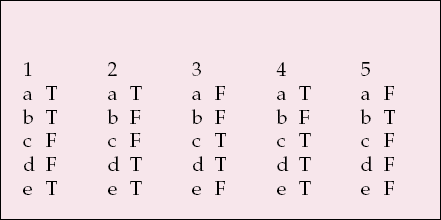
| ane | ii | iii | 4 | five | |||||
|---|---|---|---|---|---|---|---|---|---|
| a | T | a | T | a | F | a | T | a | F |
| b | T | b | F | b | F | b | F | b | T |
| c | F | c | F | c | T | c | T | c | F |
| d | F | d | T | d | T | d | T | d | F |
| e | T | e | T | e | F | e | T | e | F |
References
Albeniz, A. & Holmes, J. (2000) Meditation: concepts, furnishings and uses in therapy. International Journal of Psychotherapy, 5, 49–58.CrossRefGoogle Scholar
Bishop, S. R. , Lau, M. , Shapiro, S. et al (2004) Mindfulness: a proposed operational definition. Clinical Psychology: Science and Practice, 11, 230–241.Google Scholar
Dark-brown, D. P. & Engler, J. (1986) The stages of mindfulness meditation: a validation written report. In Transformations of Consciousness (eds Wilber, K. , Engler, J. & Chocolate-brown, D. P. ) pp. 161–191. Shambala Press.Google Scholar
Brown, Yard. & Ryan, R. (2003) The benefits of being present: mindfulness and its office in psychological well being. Journal of Personality and Social Psychology, 84, 822–848.CrossRefGoogle ScholarPubMed
Brown, Thousand. Westward. & Ryan, R. M. (2004) Perils and promise in defining and measuring mindfulness. Clinical Psychology: Scientific discipline and Practice, 11, 242–248.Google Scholar
Coltart, N. (1993) Slouching towards Bethlehem: And Further Psychoanalytic Explorations. Costless Clan Books.Google Scholar
Coltart, N. (1998) Slouching towards Buddhism: a chat with Nina Coltart. In The Couch and the Tree: Dialogues Between Psychoanalysis and Buddhism (ed. Molino, A. ) pp. 170–182. Due north Point Printing.Google Scholar
Davidson, R. J. , Kabat-Zinn, J. , Schumacher, J. et al (2003) Alterations in brain and allowed function produced by mindfulness meditation. Psychosomatic Medicine, 65, 564–570.CrossRefGoogle ScholarPubMed
Epstein, M. (1996) Thoughts without a Thinker. Duckworth.Google Scholar
Epstein, Chiliad. (1998) Going to Pieces without Falling Apart. Thorsons.Google Scholar
Fonagy, P. , Gergely, One thousand. , Jurist, Due east. et al (2002) Bear upon Regulation, Mentalization and the Development of the Self. Other Press.Google Scholar
Freud, S. (1912) Recommendations for physicians on the psychoanalytic method of handling. Reprinted (1953–1974) in the Standard Edition of the Complete Psychological Works of Sigmund Freud (trans. and ed. Strachey, J. ) vol. 12. Hogarth Press.Google Scholar
Germer, C. K. (2005) What is mindfulness? In Mindfulness and Psychotherapy (eds Germer, C. K. , Siegel, R. D. & Fulton, P. R. ) pp. i–27. Guilford Press.Google Scholar
Hayes, Southward. C. , Strosahl, K. D. & Wilson, K. D. (1999) Acceptance and Commitment Therapy: An Experiential Approach to Behavior Change. Guilford Press.Google Scholar
Horney, K. (1951) The quality of the analyst'southward attending. Reprinted (1999) in Karen Horney: The Therapeutic Procedure (ed. Paris, B. J. ) pp. 186–190. Yale University Press.Google Scholar
Kabat-Zinn, J. (1990) Full Catastrophe Living: Using the Wisdom of Your Body and Listen to Confront Stress, Pain, and Illness. Delacorte Press.Google Scholar
Kabat-Zinn, J. (1994) Mindfulness Meditation for Everyday Life. Piatkus Books.Google Scholar
Kristeller, J. 50. & Hallett, C. B. (1999) An exploratory report of a meditation-based intervention for binge eating disorder. Journal of Wellness Psychology, 4, 357–363.CrossRefGoogle ScholarPubMed
Linehan, M. (1993) Skills Grooming Manual for Treating Borderline Personality Disorder. Guilford Press.Google Scholar
Mace, C. (2006a) Long-term impacts of mindfulness practice on wellbeing: new findings from qualitative enquiry. In Dimensions of Well-being. Research and Intervention (ed. Delle Fave, A. ) pp. 455–469. Franco Angeli.Google Scholar
Mace, C. (2006b) Mindfulness and technologies of healing: lessons from Western practice. Proceedings of Second Kyoto Conference on Buddhism and Psychotherapy (eds Ancho, O. , Miller, M. & Mathers, D. ) pp. 151–161. Hanazono University.Google Scholar
Mace, C. (2007) Mindfulness and Mental Wellness. Brunner-Routledge.Google Scholar
Reibel, D. K. , Greeson, J. Thousand. , Brainard, Thousand. C. et al (2001) Mindfulness-based stress reduction and health-related quality of life in a heterogeneous patient population. General Hospital Psychiatry, 23, 183–192.CrossRefGoogle Scholar
Roemer, L. & Orsillo, S. M. (2002) Expanding our conceptualisation of and handling for generalised feet disorder. Integrating mindfulness/acceptance-based approaches with existing cerebral–behavioural models. Clinical Psychology: Scientific discipline and Do, 9, 54–68.Google Scholar
Segal, Z. , Williams, J. G. Yard. & Teasdale, J. (2002) Mindfulness Based Cognitive Therapy for Depression. John Wiley & Sons.Google Scholar
Teasdale, J. D. , Segal, Z. V. , Williams, J. M. G. et al (2000) Prevention of relapse/recurrence in major depression past mindfulness-based cognitive therapy. Journal of Consulting and Clinical Psychology, 128, 615–623.CrossRefGoogle Scholar
Welch, Southward. South. , Rizvi, South. & Dimidjian, S. (2006) Mindfulness in dialectical beliefs therapy (DBT) for borderline personality disorder. In Mindfulness-based Treatment Approaches: Clinician'south Guide to Evidence Base of operations and Applications (ed. Baer, R. A. ) pp. 117–139. Academic Press.CrossRefGoogle Scholar
Source: https://www.cambridge.org/core/journals/advances-in-psychiatric-treatment/article/mindfulness-in-psychotherapy-an-introduction/FB9E0A4DAA70BA12FDBFCDC6DDD0A063
0 Response to "according to kristeller, whats one way that behavioral therapy and meditation differ?"
Publicar un comentario