When Did Piracy Start Coming Up Again
| Golden Age of Piracy | |
|---|---|
| 1650s–1730s | |
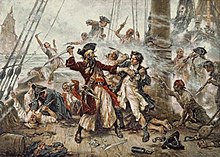 Blackbeard battles Lt. Maynard at the height of the Golden Historic period of Piracy | |
| Location |
|
The Golden Age of Piracy is a common designation for the period between the 1650s and the 1730s, when maritime piracy was a meaning factor in the histories of the Caribbean, the United kingdom of great britain and northern ireland, the Indian Body of water, North America, and West Africa.
Histories of piracy often subdivide the Golden Age of Piracy into three periods:
- The buccaneering catamenia (approximately 1650 to 1680), characterized by Anglo-French seamen based in Jamaica and Tortuga attacking Spanish colonies, and shipping in the Caribbean and eastern Pacific.
- The Pirate Circular (1690s), associated with long-altitude voyages from the Americas to rob Muslim and East India Company targets in the Indian Bounding main and Red Ocean.
- The post-Spanish Succession period (1715 to 1726), when Anglo-American sailors and privateers left unemployed by the end of the War of the Spanish Succession turned en masse to piracy in the Caribbean area, the Indian Bounding main, the North American eastern seaboard, and the Due west African declension.
Narrower definitions of the Gold Age sometimes exclude the first or second periods, but most include at least some portion of the third. The mod conception of pirates as depicted in popular culture is derived largely, although non always accurately, from the Golden Age of Piracy.
Factors contributing to piracy during the Golden Historic period included the rising in quantities of valuable cargoes being shipped to Europe over vast ocean areas, reduced European navies in sure regions, the grooming and feel that many sailors had gained in European navies (specially the British Regal Navy), and decadent and ineffective government in European overseas colonies. Colonial powers at the time constantly fought with pirates and engaged in several notable battles and other related events.
Name of the Golden Age [edit]
Origin [edit]
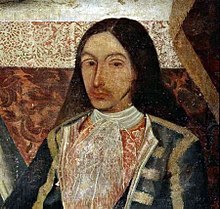
Amaro Pargo, one of the most famous corsairs of the Golden Age of Piracy
The oldest known literary mention of a "Golden Age" of piracy is from 1894, when the English language announcer George Powell wrote near "what appears to have been the golden age of piracy upwardly to the last decade of the 17th century."[1] Powell uses the phrase while reviewing Charles Leslie's A New and Exact History of Jamaica, so over 150 years old. Powell uses the phrase only once.
In 1897, a more than systematic utilize of the phrase "Aureate Age of Piracy" was introduced past historian John Fiske, who wrote, "At no other time in the world'due south history has the business organisation of piracy thriven so greatly every bit in the seventeenth century and the first part of the eighteenth. Its golden age may be said to have extended from about 1650 to near 1720."[2] Fiske included the activities of the Barbary corsairs and East Asian pirates in this "Gold Historic period," noting that "as these Mussulman pirates and those of East asia were as busily at work in the seventeenth century as at any other time, their case does not impair my statement that the age of the buccaneers was the Gilt Age of piracy."[iii]
Pirate historians of the first half of the 20th century occasionally adopted Fiske's term "Gilt Age," without necessarily following his beginning and catastrophe dates for information technology.[4] The well-nigh expansive definition of an age of piracy was that of Patrick Pringle, who wrote in 1951 that "the virtually flourishing era in the history of piracy ... began in the reign of Queen Elizabeth I and ended in the second decade of the eighteenth century."[5] This idea starkly contradicted Fiske, who had hotly denied that such Elizabethan figures equally Drake were pirates.[half-dozen]
Tendency toward narrow definitions [edit]
Of recent definitions, that given by Pringle appears to have the widest range, an exception to an overall trend among historians from 1909 until the 1990s, toward narrowing the Golden Age. Every bit early on as 1924, Philip Gosse described piracy equally beingness at its peak "from 1680 until 1730." In his highly pop 1978 book The Pirates for TimeLife's The Seafarers serial, Douglas Botting defined the Golden Age as lasting "barely xxx years, starting at the shut of the 17th Century and ending in the start quarter of the 18th."[7] Botting's definition was closely followed by Frank Sherry in 1986.[8] In a 1989 academic article, Professor Marcus Rediker defined the Golden Age as lasting only from 1716 to 1726.[9] Angus Konstam in 1998, reckoned the era every bit lasting from 1700 until 1730.[10]
Mayhap the ultimate footstep in restricting the Golden Age was in Konstam's 2005 The History of Pirates, in which he retreated from his own earlier definition, called a 1690–1730 definition of the Golden Age "generous," and ended that "The worst of these pirate excesses was limited to an eight-yr period, from 1714 until 1722, so the truthful Aureate Age cannot even be chosen a 'gilt decade.'"[11]
Recent countertrend toward broader significant [edit]
David Cordingly, in his influential 1994 piece of work Under the Black Flag, defined the "great age of piracy" as lasting from the 1650s to around 1725, very close to Fiske's definition of the Golden Age.[12]
Rediker, in 2004, described the most complex definition of the Golden Age to date. He proposes a "golden age of piracy, which spanned the period from roughly 1650 to 1730," which he subdivides into three singled-out "generations": the buccaneers of 1650–1680, the Indian Bounding main pirates of the 1690s, and the pirates of the years 1716–1726.[13]
Martin Mares, drawing on both Cordingly and Rediker, took their arguments well-nigh the periodization of the Golden Historic period of Piracy even further in his seminal piece of work The British Contribution to the Development of Piracy in the Golden Age of Piracy, proposing that the longer periodization can exist also understood every bit an uninterrupted and continuous procedure with its points of peaks and regressions.[14] Too, Mares argued that such interpretation allows united states to fully sympathize how the golden historic period of piracy helped the British to develop the understanding of their imperial policy as i unmarried domain with interconnected interests rather than split Western and Eastern spheres of influence.[15] This argument was later reinforced from the economic perspective by Nicolás Rodríguez Arosemena.[16] Arosemena, using the analysis of Jamaica'southward evolution from the work of Martin Mares, proposes that empirical data collected by Mares has wider implications–nigh notably – legal ones such as the recognition of ius cogens even before the Industrial Revolution in terms of unfair enrichment, since "information technology is perfectly possible to have islands of prosperity within a sea of misery. And of course, if we only sample the islands, the earth will look like a paradise."[sixteen]
History [edit]
Piracy arose out of, and mirrored on a smaller scale, conflicts over trade and colonization among the rival European powers of the fourth dimension, including the empires of Britain, Spain, the Netherlands, Portugal, and French republic. Near pirates in this era were of Welsh, English language, Dutch, Irish gaelic, and French origin. Many pirates came from poorer urban areas in search of a way to make money and reprieve. London in particular was known for high unemployment, crowding, and poverty which drove people to piracy. Piracy besides offered ability and quick riches.
Buccaneering menses, c. 1650–1680 [edit]
Historians such as John Fiske mark the beginning of the Gilt Age of Piracy at effectually 1650, when the end of the Wars of Religion allowed European countries to resume the development of their colonial empires. This involved considerable seaborne trade and a general economic improvement: there was coin to exist made – or stolen – and much of it traveled by transport.
French buccaneers had established themselves on northern Hispaniola as early as 1625,[17] but lived at showtime generally as hunters rather than robbers[ clarification needed ]; their transition to full-time piracy was gradual and motivated in part by Spanish efforts to wipe out both the buccaneers and the prey animals on which they depended. The buccaneers' migration from Hispaniola's mainland to the more defensible offshore isle of Tortuga limited their resources and accelerated their piratical raids. According to Alexandre Exquemelin, a buccaneer and historian who remains a major source on this period, the Tortuga buccaneer Pierre Le Grand pioneered the settlers' attacks on galleons making the return voyage to Espana.
The growth of buccaneering on Tortuga was augmented by the English capture of Jamaica from Kingdom of spain in 1655. The early English language governors of Jamaica freely granted letters of marque to Tortuga buccaneers and to their ain countrymen, while the growth of Port Royal provided these raiders with a far more profitable and enjoyable place to sell their booty. In the 1660s, the new French governor of Tortuga, Bertrand d'Ogeron, similarly provided privateering commissions both to his own colonists and to English cutthroats from Port Royal. These conditions brought Caribbean buccaneering to its zenith.
Pirate Round, c. 1693–1700 [edit]

Henry Every is shown selling his boodle in this engraving by Howard Pyle. Every'southward capture of the Thou Mughal ship Ganj-i-Sawai in 1695 stands as one of the most profitable pirate raids always perpetrated.
A number of factors caused Anglo-American pirates, some of whom had been introduced to piracy during the buccaneering period, to look across the Caribbean for treasure equally the 1690s began. The end of Britain's Stuart period had restored the traditional enmity between Britain and France, thus ending the profitable collaboration betwixt English Jamaica and French Tortuga. The devastation of Port Majestic by an earthquake in 1692 farther reduced the Caribbean's attractions by destroying the pirates' chief market for fenced plunder.[18] Caribbean colonial governors began to discard the traditional policy of "no peace across the Line," under which it was understood that state of war would proceed (and thus messages of marque would be granted) in the Caribbean regardless of peace treaties signed in Europe; henceforth, commissions would be granted only in wartime, and their limitations would be strictly enforced. Furthermore, much of the Spanish Master had just been exhausted; Maracaibo alone had been sacked three times between 1667 and 1678,[19] while Río de la Hacha had been raided five times and Tolú eight.[twenty]
At the aforementioned fourth dimension, England's less-favored colonies, including Bermuda, New York, and Rhode Island, had become cash-starved by the Navigation Acts. Merchants and governors eager for money were willing to overlook and even underwrite pirate voyages; one colonial official defended a pirate because he idea it "very harsh to hang people that brings in gold to these provinces."[21] Although some of these pirates operating out of New England and the Heart Colonies targeted Kingdom of spain's more remote Pacific coast colonies well into the 1690s and beyond, the Indian Sea was a richer and more tempting target. India's economical output dwarfed Europe'due south during this fourth dimension, specially in loftier-value luxury goods such as silk and calico, which made ideal pirate booty;[22] at the same time, no powerful navies plied the Indian Ocean, leaving both local shipping and the various Eastward India companies' vessels vulnerable to assault. This set the stage for the famous piracies of Thomas Tew, Henry Every, Robert Culliford, and (although his guilt remains controversial) William Kidd.
Post–Spanish Succession period, c. 1715–1726 [edit]
In 1713 and 1714, a series of peace treaties concluded the War of the Spanish Succession. As a result, thousands of seamen, including U.k.'s paramilitary privateers, were relieved of military duty, at a fourth dimension when cantankerous-Atlantic colonial aircraft merchandise was first to blast. In addition, Europeans who had been pushed by unemployment to become sailors and soldiers involved in slaving were oft enthusiastic to abandon that profession and turn to pirating, giving pirate captains a steady pool of recruits in Westward African waters and coasts.
In 1715, pirates launched a major raid on Spanish divers trying to recover gold from the sunken treasure galleon Urca de Lima nearly Florida. The nucleus of the pirate force was a group of English ex-privateers, all of whom would soon exist enshrined in infamy: Henry Jennings, Charles Vane, Samuel Bellamy of Whydah Gally fame, Benjamin Hornigold, and Edward England. The attack was successful, but contrary to their expectations, the governor of Jamaica refused to allow Jennings and his cohorts to spend their loot on his island. With Kingston and the declining Port Royal airtight to them, Hornigold, Jennings, and their comrades based themselves at Nassau, on the isle of New Providence in the Bahama islands. Nassau would be dwelling for these pirates and their many recruits until the arrival of Governor Woodes Rogers in 1718, which signalled the end of the Republic of Pirates. Rogers and other British governors had the authority to pardon pirates under the Rex's Human activity of Grace: while Hornigold accepted this pardon to go a privateer, others such as Blackbeard returned to piracy following their pardon.[23]
Transatlantic shipping traffic between Africa, the Caribbean, and Europe began to soar in the 18th century, a model known as the Triangular Merchandise, and became a rich target for piracy. Trade ships sailed from Europe to the African coast, trading manufactured goods and weapons for slaves. The traders would and so sail to the Caribbean area to sell the slaves, and return to Europe with goods such as carbohydrate, tobacco, and cocoa. In some other Triangular Trade route, ships would carry raw materials, preserved cod, and rum to Europe, where a portion of the cargo would be sold for manufactured goods, which (forth with the residual of the original load) were then transported to the Caribbean, where they were exchanged for saccharide and molasses, which (with some manufactured manufactures) were then borne to New England. Ships in the Triangular Merchandise often made money at each finish.[24]
As part of the settlement of the State of war of the Castilian Succession, Britain obtained the asiento, a Castilian government contract to supply slaves to Espana's New Globe colonies, which provided British traders and smugglers more admission to formerly airtight Spanish markets in America. This arrangement also contributed heavily to the spread of piracy across the western Atlantic. Shipping to the colonies boomed along with the flood of skilled mariners after the war. Merchant shippers used the surplus of labor to drive wages down, cut corners to maximize profits, and create unsavory atmospheric condition aboard their vessels. Merchant sailors suffered from mortality rates equally high or college than the slaves being transported.[25] Living conditions were so poor that many sailors began to prefer a freer being as pirates.[ citation needed ] The increased book of shipping traffic also could sustain a large body of brigands preying upon information technology.
During this time, many of the pirates had originally been either sailors for the Purple Navy, privateersmen, or merchant seamen. Virtually pirates had experience living on the sea, and knew how harsh the conditions could be. Sailors for the king would oftentimes have very little to swallow while out on the sea, and would cease up ill, starving, and dying. That resulted in some sailors deserting the king and becoming pirates instead. This besides allowed for pirates to amend fight the navy. Dissimilar other seamen, pirates had strict rules for how they were to be treated on the transport. Contrary to popular belief, pirate captains did not take a dictatorship over the remainder of the pirates on their ship. Captains had to be voted in, and there were strict rules for them to follow as well. The captain was not treated improve (with more nutrient, better living conditions, etc.) than the other members of the crew, and was expected to treat the crew with respect. This was in deliberate contrast to merchant captains, who often treated their crews terribly. Many pirates had formerly served on these merchant ships and knew how horrid some captains could be. Considering of this, ships often implemented councils composed of all of the crew members on the send. Some councils were used daily to make ordinary decisions, while others were used as a court system only when criminal incidents or legal matters necessitated it. Whatever the case, crewmembers on pirate vessels often had equally much power equally the captain outside of battle. The captain but had total potency in times of battle and could be removed from this position if he showed cowardice in the face of the enemy.[26] He was likewise to be bold in boxing. The pirates did non want things to end upwards the same way as on a navy ship.[27]
Render of the Pirate Circular [edit]
Between the years 1719 and 1721, Edward England, John Taylor, Olivier Levasseur, and Christopher Condent operated from Madagascar. Taylor and Levasseur reaped the greatest prize in the history of the Gilt Age of Piracy, the plunder of the Portuguese East Indiaman Nossa Senhora Do Cabo at Réunion in 1721, stealing diamonds and other treasures worth a full of £800,000.
Condent was likewise a successful pirate, just England was not. He was marooned on Union of the comoros past Taylor and Levasseur in 1721, and died non long afterward. Despite the success of Taylor and Levasseur, the Pirate Round quickly declined again. Edward Teach, the notorious "Blackbeard", died in boxing in a fight with Lieutenant Robert Maynard's navy send. He was allegedly stabbed twenty times and shot five times before death.
Pirates of the era [edit]

Blackbeard'southward severed head hanging from Maynard'southward bowsprit
Many of the best-known pirates in historical lore originate from this Golden Historic period of Piracy:
- "Black Sam" Bellamy, captain of the Whydah Gally, was lost in a tempest off Cape Cod in 1717. Bellamy was popularly known equally the "Robin Hood of pirates" and prided himself on his ideological justifications for piracy.
- Stede Bonnet, a rich Barbadian country possessor turned pirate solely in search of adventure. Bonnet captained a 10-gun sloop named the Revenge and raided ships off the Virginia coast in 1717. He was caught and hanged in 1718.
- Henry Every, one of the few major pirate captains to retire with his boodle without beingness arrested nor killed in boxing. He is famous for capturing the fabulously wealthy Mogul ship Ganj-i-Sawai in 1695.
- Olivier Levasseur, aka La Buse, the but major French pirate in Nassau who was ofttimes associated with Hornigold, Bellamy, Kennedy, and Taylor.
- William Fly, whose execution in 1726 is used by historian Marcus Rediker to mark the terminate of the Golden Age of Pirates.
- William "Captain" Kidd, executed for piracy at Execution Dock, London, in 1701, is famous for the "buried treasure" he supposedly left behind.
- Edward Low, built-in in Westminster, was active 1721–1724, was never captured, and was notorious for torturing his victims earlier killing them; he would cut off ears, lips, and noses.
- Henry Morgan, a buccaneer who raided the Spaniards and took Panama City earlier burning it to the ground. He was to be executed in England, just was instead knighted and fabricated governor of Jamaica. He died a natural death in 1688.
- John "Calico Jack" Rackham, famous for his partnership with female person pirates Anne Bonny and Mary Read, was captured, then hanged and gibbeted exterior Port Regal, Jamaica, in 1720.
- Bartholomew "Black Bart" Roberts, is considered by many to be the most successful Western pirate of all time with over 400 transport captures.
- Edward "Blackbeard" Teach (Thatch), active from 1716 to 1718, is maybe the most notorious pirate among English language-speaking nations. Blackbeard'south most famous ship was the Queen Anne's Revenge, named in response to the end of Queen Anne's War.[ citation needed ] He was killed by one of Lieutenant Robert Maynard's crewmen in 1718.
- Charles Vane, a particularly tearing and unrepentant pirate, who served under Henry Jennings before striking out on his own. Harsh and unpopular with his coiffure, Vane was marooned before beingness captured and hanged in 1721.
- Benjamin Hornigold, an English pirate who helped found the Republic of Pirates and mentored Blackbeard before taking a royal pardon and becoming a pirate hunter
- Amaro Pargo, a prominent Spanish corsair who dominated the road between Cádiz and the Caribbean area. His figure has been wrapped in a halo of romanticism and legend that have linked him to piracy, subconscious treasures, and illicit romances. In the marble headstone of his tomb in San Cristóbal de La Laguna is engraved a skull winking his right eye with two crossbones.
Female pirates [edit]
The best-known female person pirates were Anne Bonny, Mary Read, and Rachel Wall.
Anne Bonny (1697–1721) adult a notorious reputation in Nassau. When she was unable to exit an earlier marriage, she eloped with her lover, Calico Jack Rackham.
Mary Read had been dressed every bit a boy all her life by her mother and had spent fourth dimension in the British war machine. She came to the West Indies (Caribbean) afterwards leaving her hubby and joined Calico Jack'due south crew after he attacked a transport she had been aboard. She divulged her gender only to Bonny at first, only revealed herself openly when accused by Rackham of having an matter with Bonny.[28]
The nature of the relationships betwixt Attractive, Read, and Rackham take been speculated to be romantic and/or sexual in various combinations, though there is no definitive proof. In David Cordingly's 2001 book Women Sailors and Sailors' Women: An Untold Maritime History, Cordingly suggests that Bonny and Read were sexually involved.[29]
When their transport was attacked in 1720, Bonny, Read, and an unknown man were the only ones to defend it; the other crew members were too drunk to fight. In the stop they were captured and arrested. After their capture, both women were convicted of piracy and sentenced to decease, but they stalled their executions past claiming to be significant. Read died in jail months later, many believe of a fever or complications of childbirth. Bonny disappeared from historical documents, and no record of her execution nor a childbirth exist.[30]
Barbary pirates or privateers [edit]

Cornelis Hendricksz Vroom, Spanish Men-of-War Engaging Barbary Corsairs, 1615.
The Barbary pirates were pirates and privateers that operated from the N African (the "Barbary coast") ports of Algiers, Morocco, Salé, Tripoli, and Tunis, preying on aircraft in the western Mediterranean Bounding main from the time of the Crusades too as on ships on their way to Asia around Africa until the early on 19th century. The coastal villages and towns of Italy, Spain and Mediterranean islands were frequently attacked by them, and long stretches of the Italian and Spanish coasts were almost completely abandoned by their inhabitants; since the 17th century, Barbary pirates occasionally entered the Atlantic and struck every bit far northward as Iceland. According to Robert Davis,[31] [32] betwixt ane million and one.25 million Europeans were captured past Barbary pirates and sold as slaves in Northern Africa betwixt the 16th and 19th centuries.
Barbary pirates flourished in the early 17th century as new sailing rigs by Simon de Danser enabled North African raiders, for the kickoff time, to brave the Atlantic as well every bit Mediterranean waters. More than 20,000 captives were said to be imprisoned in Algiers lonely. The rich were allowed to redeem themselves, merely the poor were condemned to slavery. Their masters would on occasion allow them to secure freedom by professing Islam. Many people of good social position–Germans, Italians, Spaniards, and English travelers in the s–were captives for a time.[33]
In 1627, Iceland was field of study to raids known every bit the Turkish Abductions. Murat Reis is said to have taken 400 prisoners; 242 of the captives were later sold into slavery on the Barbary Coast. The pirates took only young people and those in adept physical status. All those offer resistance were killed, and the old people were gathered into a church, which was fix on fire. Among those captured was Ólafur Egilsson, who was ransomed the next year and, upon returning to Iceland, wrote a slave narrative most his experience. Some other famous convict from that raid was Guðríður Símonardóttir. The sack of Vestmannaeyjar is known in the history of Iceland as Tyrkjaránið.
Ane of the stereotypical features of a pirate in popular civilisation, the heart patch, dates back to the Arab pirate Rahmah ibn Jabir al-Jalahimah, who wore it later on losing an center in boxing in the 18th century.[34]
Whilst the Golden Age of European and American pirates is more often than not considered to have concluded betwixt 1710 and 1730, the prosperity of the Barbary pirates continued until the early 19th century. Unlike the European powers, the immature U.s. refused to pay tribute to the Barbary states and responded with the First Barbary State of war and the Second Barbary War confronting Due north Africa, when the Barbary pirates captured and enslaved American sailors. Although the U.Southward. had only limited success in these wars, France and Bang-up U.k., with their more powerful navies, shortly followed suit and stamped out the Barbary raiders.[ commendation needed ]
Buccaneers [edit]
Buccaneers operated mainly in the Caribbean. They originated in Tortuga around the 17th century equally hunters, just became "pirates" when government officials would pay groups of men to set on and loot Castilian ships. These buccaneers would later begin attacking any ship worth of value, enemy or not.[ citation needed ]
Privateers [edit]
Privateers were private persons who engaged in maritime warfare under a commission of war. The commissions were known as "letters of marque", which gave them the authority to raid enemy ships and exemption from piracy charges.[ commendation needed ]
Decline [edit]
Past the early 18th century, tolerance for privateers was wearing thin in all nations. Later on the Treaty of Utrecht was signed, the excess of trained sailors without employment was both a blessing and a curse for all pirates. Initially, the surplus of men had acquired the number of pirates to multiply significantly. This inevitably led to the pillaging of more ships, which put a greater strain on trade for all European nations. In response, European nations bolstered their ain navies to offer greater protection for merchants and to chase down pirates. The excess of skilled sailors meant at that place was a large pool that could be recruited into national navies as well.
Piracy was clearly on a stiff decline by 1720. The Gilded Historic period of Piracy did not last the decade.
The events of the latter half of 1718 (including the arrival of Governor Woodes Rogers in Nassau) stand for a turning point in the history of piracy in the New World. Without a rubber base of operations and with growing pressure from naval forces, the rovers lost their momentum. The lure of the Spanish treasures had faded, and the hunters gradually became the hunted. By early 1719, the remaining pirates were on the run. Most of them headed for West Africa, seizing poorly dedicated slavers.[35]
Effect on popular culture [edit]
Stories and histories from the Golden Age course the foundation for many modern depictions of pirates and piracy. A Full general History of the Pirates (1724) past Captain Charles Johnson is the prime number source for the biographies of many well known pirates of the Golden Historic period, providing an extensive account of the catamenia.[36] In giving an almost mythical status to the more colorful characters such as the notorious English pirates Blackbeard and Calico Jack, information technology is probable that the author used considerable license in his accounts of pirate conversations.[36] In 2002, English language naval historian David Cordingly wrote an introduction to Johnson'south 1724 volume, stating: "it has been said, and there seems no reason to question this, that Captain Johnson created the mod conception of pirates."[36] Johnson'south book would influence the pirate literature of Robert Louis Stevenson and J. K. Barrie.[36] Such literary works equally Stevenson's Treasure Island and Barrie'south Peter Pan, while romanticized, drew heavily on pirates and piracy for their plots.[37]
Various claims and speculation about their overall prototype, attire, manner, wearing apparel code, etc. have been made and contributed to their fanciful mystery and lore. For case, men wore earrings as the value of the gilt or silver earring was meant to pay for their burial if they were lost at ocean and their body washed ashore. They were besides worn for superstitious reasons, believing the precious metals had magical healing powers.[38]
More recently, even less accurate depictions of historical-era pirates (e.k., Talk Like a Pirate Day) take advanced to the forefront. However, these phenomena take only served to advance the romantic paradigm of piracy and its treasure-burying swashbucklers in popular culture.[39]
See also [edit]
- Governance in 18th-century piracy
References [edit]
- ^ George Powell, "A Pirate'southward Paradise," in The Gentleman's Magazine, vol. CCLXXVI, Northward.S. 52, Jan–June 1894, p. 23.
- ^ John Fiske, 1897, Old Virginia and Her Neighbors, p. 338.
- ^ Fiske, p. 339.
- ^ R.D.Due west. Connor, 1909, Cornelius Harnett: An Essay in North Carolina History, P. ten; Francis Hodges Cooper, 1916, "Some Colonial History of Beaufort Canton, N Carolina," in James Sprunt Studies in History and Political Science, v. xiv, no. 2, p. 32.
- ^ Patrick Pringle, 1951, Jolly Roger: The Story of the Neat Age of Piracy, p. 9 of the 2001 edition.
- ^ Fiske, pp. 341–342.
- ^ Douglas Botting, 1978, The Pirates, p. twenty.
- ^ Frank Sherry, 1986, Raiders and Rebels: The Golden Age of Piracy, p. 7.
- ^ Marcus Rediker, 1989, "'Under the Banner of Rex Death': The Social Earth of Anglo-American Pirates 1716–1726", William and Mary Quarterly, ser. 3, 38 (1981), 203–227.
- ^ F; Konstam, supra, p. v.
- ^ Angus Konstam, 2005, The History of Pirates, p. 96.
- ^ David Cordingly, 1995, Nether the Black Flag: The Romance and Reality of Life Amid the Pirates, pp. xvi–xvii.
- ^ Marcus Rediker, 2004, Villains of All Nations, p. 8.
- ^ Mares, Martin (2019). The Golden Historic period of Piracy and the British Contribution to its Development. Smiling Verlag. ISBN978-3-346-08101-8.
- ^ Mares, Martin. "The Function of Jamaica in Fostering Maritime Piracy In the Atlantic Ocean, 1655–1702".
- ^ a b Rodríguez Arosemena, Nicolás (2018-12-15). "The Dominium Mundi Game and the Case for Artificial Intelligence in Economics and the Constabulary".
- ^ "Tortuga – Pirate History – The Way of the Pirates". world wide web.thewayofthepirates.com.
- ^ Nigel Cawthorne (2005), Pirates: An Illustrated History, Arturus Publishing Ltd., 2005, p. 65.
- ^ Cawthorne, pp. 34, 36, 58
- ^ Peter Earle (2003), The Pirate Wars, ISBN 0-312-33579-2, p. 94.
- ^ Earle, p. 148.
- ^ Geoffrey Parker, ed. (1986), The World: An Illustrated History, Times Books Ltd., p. 317.
- ^ Snow, Edward Rowe (1944). Pirates and Buccaneers of the Atlantic Coast. Boston, Massachusetts: The Yankee Publishing Company. pp. 252, 256, 268–270, 299.
- ^ Mark Kurlansky, Cod: A Biography of the Fish That Changed the World. Penguin, 1998.
- ^ Rediker, 2004
- ^ Rediker, Marcus (1981). ""Nether the Banner of Rex Expiry" The Social Earth of Anglo-American Pirates". The William and Mary Quarterly. 38 (2): 203–227. doi:ten.2307/1918775. JSTOR 1918775. S2CID 147395597.
- ^ Rediker, 1981
- ^ Commire, Anne & Klezmer, Deborah (2002). "Read, Mary and Anne Bonney". Women in Earth History: A Biographical Encyclopedia. Gale. ISBN078764062X.
{{cite encyclopedia}}: CS1 maint: uses authors parameter (link) - ^ Cordingly, David (2001). Women Sailors and Sailors' Women: An Untold Maritime History. New York: Random Firm. ISBN0375500413.
- ^ Cordingly, David. "Bonny, Anne (1698–1782)". Oxford Lexicon of National Biography (online ed.). Oxford University Printing. doi:10.1093/ref:odnb/39085. (Subscription or UK public library membership required.)
- ^ Davis, Robert. "When Europeans were slaves: Research suggests white slavery was much more common than previously believed". Ohio State Research News. Archived from the original on 2011-07-25.
- ^ Davis, Robert (2003). Christian Slaves, Muslim Masters: White Slavery in the Mediterranean, the Barbary Coast and Italy, 1500–1800 . Palgrave Macmillan. ISBN1-4039-4551-9.
- ^ This article incorporates text from a publication now in the public domain:Chisholm, Hugh, ed. (1911). "Barbary Pirates". Encyclopædia Britannica (11th ed.). Cambridge University Press.
- ^ Belgrave, Charles (1966). The Pirate Coast. George Bell & Sons. p. 122.
- ^ Ieuan West. Haywood (2009)
- ^ a b c d Johnson, Charles & Cordingly, David (Introduction and Commentary ) (2002). A general history of the robberies & murders of the virtually notorious pirates. Conway Maritime Printing. p. viii. ISBN9780851779195.
{{cite volume}}: CS1 maint: multiple names: authors list (link) - ^ Adams, Cecil (October five, 2007). "Did pirates coffin their treasure? Did pirates really brand maps where "Ten marks the spot?". The Straight Dope.
- ^ "Why Did Pirates Wear Earrings?". livescience. 8 March 2011.
- ^ Adams, Cecil (October 12, 2007). "Why are pirates depicted with a parrot on their shoulder? What'due south the origin of the skull and crossbones pirate flag?". The Directly Dope.

Bibliography [edit]
- Flemming, Gregory (2014). At the Betoken of a Cutlass: The Pirate Capture, Bold Escape, and Lonely Exile of Philip Ashton. ForeEdge. ISBN978-1611685152.
- Piffling, Benerson (2011). How History's Greatest Pirates Pillaged, Plundered, and Got Away with It: the Stories, Techniques, and Tactics of the Most Feared Bounding main Rovers from 1500-1800. Fair Winds Press.
- Kuhn, Gabriel (2010). Life Under the Jolly Roger: Reflections on Aureate Age Piracy. PM Press.
- Little, Benerson (2016). The Gilt Historic period of Piracy: the Truth Behind Pirate Myths. Skyhorse Publishing.
- Lunsford, Virginia (2005). Piracy and Privateering in the Golden Age Netherlands. Palgrave Macmillan. ISBN1403966923.
- Rediker, Marcus (1988). "Pirates and the Royal Land". Reviews in American History. Vol. sixteen, no. 3. pp. 351–357.
- Rediker, Marcus (2004). Villains of all Nations: Atlantic Pirates in the Aureate Historic period. Boston: Beacon Press.
- Sherry, Frank (2008). Raiders and Rebels the Gold Age of Piracy. Harper Perennial.
- Swanson, Carl Due east. (1985). "American Privateering and Regal Warfare, 1739–1748". The William and Mary Quarterly. Vol. 42, no. 3. pp. 357–382.
- Moss, Jeremy (2020). The Life and Tryals of the Gentleman Pirate, Major Stede Bonnet. Koehler Books. ISBN 978-1646631513.
External links [edit]
- Fleming, Greg. "America'due south Worst Pirates". gregflemming.com.
- "Golden Age of Piracy". goldenageofpiracy.org.
- "The Gilded Historic period of Piracy". The UnMuseum.
- Vallar, Cindy. "The Golden Historic period of Piracy". cindyvallar.com.
Source: https://en.wikipedia.org/wiki/Golden_Age_of_Piracy
0 Response to "When Did Piracy Start Coming Up Again"
Publicar un comentario